


 INDIA ASIAN GAMES MEDAL MONITOR
·
India: 🥇 0
| 🥈 0
| 🥉 0
| Total: 0
INDIA ASIAN GAMES MEDAL MONITOR
·
India: 🥇 0
| 🥈 0
| 🥉 0
| Total: 0
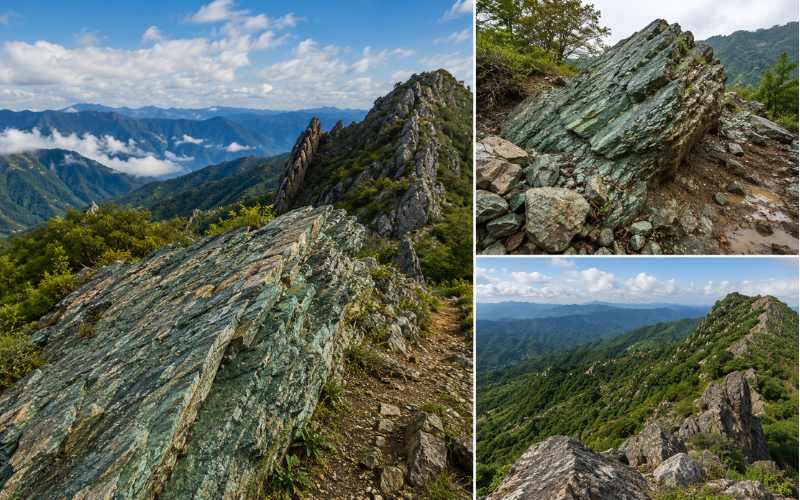
Naga Hill Ophiolite Site: A Window into Earth's Ancient Ocean
Nestled in the Naga Hills along the Indo-Myanmar border, the Naga Hill Ophiolite Site is one of India's most remarkable geological heritage sites. The ophiolite belt extends across parts of Nagaland, Manipur, and Arunachal Pradesh, forming a significant segment of the Indo-Myanmar Orogenic Belt. Though spread over a vast region, the exposures in the Naga Hills are among the most scientifically important, preserving evidence of an ancient ocean that disappeared millions of years ago.
At first glance, the landscape appears to be a series of rugged hills draped in dense forests. Hidden within these hills, however, are rocks that were never meant to be seen on land. They originated deep beneath an ancient ocean and were later pushed onto the continent by powerful tectonic forces. Today, these rocks provide scientists with a rare opportunity to study the Earth's oceanic crust and upper mantle without venturing beneath the sea.
What is an Ophiolite?
The word ophiolite comes from the Greek words ophis (snake) and lithos (stone), a name inspired by the green, snake-skin appearance of serpentinite, one of its most common rocks. In geological terms, an ophiolite is a section of the Earth's oceanic crust and the underlying upper mantle that has been uplifted and emplaced onto continental land.
Normally, the oceanic crust lies several kilometres beneath the world's oceans and is eventually recycled into the Earth's mantle through subduction. As a result, intact sections of ancient oceanic crust are rarely preserved. Ophiolites are therefore invaluable because they allow scientists to examine parts of the ocean floor directly on land.
A Legacy of the Ancient Tethys Ocean
The Naga Hill Ophiolite tells the story of the Tethys Ocean, a vast ocean that once separated the Indian landmass from Eurasia. More than 100 million years ago, the Indian Plate began drifting northward after breaking away from the supercontinent Gondwana. As it moved, the Tethys Ocean gradually narrowed until India finally collided with the Eurasian Plate around 55 million years ago.
During this collision, most of the oceanic crust sank beneath the Eurasian Plate. However, in certain regions, fragments of the ocean floor were thrust upward instead of being consumed. This process, known as obduction, preserved pieces of the ancient oceanic crust that today form the Naga Hill Ophiolite.
These rocks are silent witnesses to one of the greatest tectonic events in Earth's history—the same collision that continues to shape the Himalayas and the mountains of Northeast India.
A Journey from the Ocean Floor to the Mountains
The rocks exposed at the Naga Hill Ophiolite once lay several kilometres beneath the ocean surface. They formed at ancient mid-ocean ridges where molten magma rose from the mantle, cooled, and created new oceanic crust. Over millions of years, these rocks travelled with moving tectonic plates before being caught in the collision between India and Eurasia.
Instead of disappearing into the Earth's mantle, portions of the oceanic crust were lifted onto land. Millions of years of weathering and erosion gradually exposed them, creating the geological landscape visible today. Few places in the world preserve such a complete record of this extraordinary journey.
A Natural Laboratory for Earth Scientists
The Naga Hill Ophiolite is considered one of India's most important geological laboratories because it preserves rocks from both the Earth's mantle and its oceanic crust.
Among its most distinctive rocks is serpentinite, a greenish rock formed when mantle rocks reacted with seawater deep beneath the ocean floor. The site also contains peridotite, dunite, gabbro, and basalt, each representing different layers of the ancient oceanic lithosphere.
Together, these rocks help scientists understand how oceanic crust forms, how continents collide, and how mountains are built. Research carried out here has contributed significantly to the study of plate tectonics, mantle evolution, hydrothermal activity, and the geological history of the Indo-Myanmar region.
Importance Beyond Geology
The significance of the Naga Hill Ophiolite extends beyond scientific research. Ultramafic rocks in the region are associated with economically important minerals such as chromite and nickel-bearing deposits, making the area valuable from a resource perspective as well. At the same time, the surrounding forests support rich biodiversity, illustrating the close relationship between geological history and ecological diversity.
For students, researchers, and educators, the site serves as a vast outdoor classroom where geological processes that are usually explained through diagrams can be observed directly in nature.
A Geological Heritage Worth Preserving
Geological heritage sites are unlike any other natural resource. While forests can regenerate and wildlife populations can recover, geological formations represent millions of years of Earth's history and cannot be recreated once destroyed.
The Naga Hill Ophiolite has therefore been recognised as one of India's important geological heritage sites, highlighting the need for its protection and sustainable management. Conserving such sites ensures that future generations can continue to study and appreciate the dynamic processes that shaped our planet.
A Destination for Geotourism
The Naga Hill Ophiolite possesses immense potential as a geotourism destination. Around the world, geological heritage sites attract visitors eager to understand Earth's history through landscapes that preserve evidence of ancient oceans, volcanoes, and mountain-building events. With responsible tourism, scientific interpretation, and improved visitor infrastructure, the Nagahill Ophiolite could emerge as a premier destination for geology enthusiasts, students, and travellers interested in the natural heritage of Northeast India.
A Story Written in Stone
The Naga Hill Ophiolite Site is far more than a collection of ancient rocks. It is a chapter from Earth's distant past, preserving the story of a vanished ocean, drifting continents, and the colossal tectonic forces that shaped the Indian subcontinent. Every rock exposed in these hills is a fragment of an ocean floor that existed millions of years before humans walked the Earth.
As one of India's finest geological heritage sites, the Naga Hill Ophiolite reminds us that beneath the forests and mountains of Northeast India lies a remarkable archive of planetary history - one that continues to deepen our understanding of the Earth's evolution and the forces that continue to shape it today.
Disclaimer: The opinions expressed in this article are those of the author's. They do not purport to reflect the opinions or views of The Critical Script or its editor.
Earth Science Related Posts












Newsletter!!!
Subscribe to our weekly Newsletter and stay tuned.
Related Comments