


 INDIA ASIAN GAMES MEDAL MONITOR
·
India: 🥇 0
| 🥈 0
| 🥉 0
| Total: 0
INDIA ASIAN GAMES MEDAL MONITOR
·
India: 🥇 0
| 🥈 0
| 🥉 0
| Total: 0
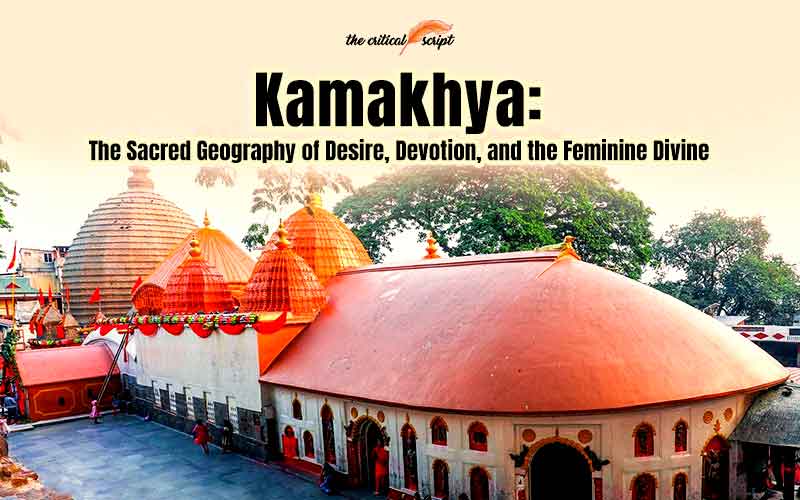
Kamakhya: The Sacred Geography of Desire, Devotion, and the Feminine Divine
Few temples in India evoke as much
fascination, reverence, and mystery as the Kamakhya Temple in Assam. Perched
atop the Nilachal Hills overlooking the broad expanse of the Brahmaputra River,
Kamakhya occupies a unique position in the religious and cultural imagination
of the Indian subcontinent. It is at once a revered Shakti Peetha, one of the
foremost centres of Tantric worship, and a living reminder of the many layers
of belief that have shaped the civilization of Northeast India.
For millions of devotees, Kamakhya is
the abode of the Mother Goddess, a place where prayers are answered and desires
fulfilled. For scholars, it represents an extraordinary convergence of tribal
traditions, Puranic mythology, and esoteric spiritual practices. For travellers
arriving in Guwahati from distant corners of the country, the temple offers an
encounter with a form of worship that challenges many conventional assumptions
about religion, purity, and the sacred.
Unlike most Hindu temples, Kamakhya
contains no sculpted image of the presiding deity. Devotees descend into a
cave-like sanctum to worship a natural rock cleft fed continuously by an underground
spring. Draped in red cloth and adorned with flowers, this ancient symbol is
revered as the manifestation of the Goddess herself. The absence of an
anthropomorphic idol is not incidental; rather, it reflects an older
understanding of divinity rooted in the forces of nature, fertility, and
creation.
The origin through classical narrative
The origins of Kamakhya are inseparable
from one of the most enduring narratives in Hindu mythology, the story of Sati
and Shiva. According to the Puranas, Sati, the daughter of King Daksha, chose
to marry Lord Shiva despite her father's objections. When Daksha organized a
grand sacrificial ritual and deliberately insulted Shiva by excluding him from
the proceedings, Sati, unable to bear the humiliation directed at her husband,
immolated herself in the sacrificial fire.
Overwhelmed by grief, Shiva wandered
across the cosmos carrying Sati's lifeless body upon his shoulders. His sorrow
manifested as the Tandava, the cosmic dance of destruction, threatening the
very balance of creation. To restore order, Lord Vishnu released his Sudarshan
Chakra, dismembering Sati's body. The places where her body parts fell became
sanctified as the Shakti Peethas, the sacred seats of the Divine Feminine.
Tradition holds that it was upon the
Nilachal Hills that Sati's yoni, the source of life and creation, fell to the
earth. This belief transformed Kamakhya into one of the holiest pilgrimage
sites in Hinduism and imbued it with a symbolism unlike that of any other
temple. Here, the feminine principle is not worshipped merely as an abstract
force but as the very source of existence itself.
The temple's association with fertility
and creative power has often invited misunderstanding, particularly among those
unfamiliar with the philosophical foundations of Shakta traditions. Yet
Kamakhya represents a worldview in which the biological processes associated
with womanhood are neither concealed nor stigmatized. Instead, they are
honoured as expressions of the sacred rhythm through which life renews itself.
Origin
beyond the classical belief
Many historians believe that Kamakhya's
origins extend beyond the framework of classical Hinduism. Long before the
emergence of the Puranic traditions, the hills of ancient Kamarupa were
inhabited by indigenous communities that worshipped local mother goddesses
connected with fertility, harvests, and the earth. The worship of a natural
stone formation rather than a carved idol, together with the temple's emphasis
on feminine generative power, has led scholars to suggest that Kamakhya may
have evolved through the gradual assimilation of tribal religious practices
into the broader Shakta fold.
This process of synthesis is perhaps one
of Kamakhya's most remarkable features. Rather than replacing older beliefs,
successive religious traditions absorbed and reinterpreted them, allowing
diverse strands of spirituality to coexist. The result is a shrine that
reflects not only theological evolution but also the cultural history of Assam
itself.
The historical development of Kamakhya
mirrors the rise and fall of kingdoms in the Brahmaputra Valley. References to
the shrine appear in the KalikaPurana, composed between the tenth and eleventh
centuries, which elevated Kamakhya to the status of one of the pre-eminent
centres of Goddess worship. Although the original structure is believed to have
suffered destruction during the sixteenth century, the temple was rebuilt under
the patronage of Koch King Naranarayana and his brother Chilarai. The
distinctive beehive-shaped dome that crowns the temple today remains one of the
most recognizable symbols of Assamese heritage.
If mythology provides Kamakhya with its
sacred narrative, Tantra gives it its spiritual distinctiveness. For centuries,
the temple has attracted practitioners of Shakta Tantra, who regard the Goddess
as the supreme manifestation of cosmic energy. Contrary to popular stereotypes
that reduce Tantra to occult practices, its philosophical foundations are
concerned with spiritual transformation through the realization of the divine
presence within all aspects of existence. At Kamakhya, the body is not viewed
as an obstacle to transcendence but as one of its pathways.
Perhaps nowhere is the temple's unique
understanding of the feminine more visible than during the annual AmbubachiMela.
Observed during the monsoon, the festival commemorates the Goddess's yearly
menstrual cycle. For three days, the sanctum remains closed as devotees believe
the Mother Goddess withdraws into seclusion. When the temple reopens, thousands
of pilgrims receive pieces of red cloth considered imbued with her blessings.
In a world where menstruation is often surrounded by silence and stigma,
Ambubachi stands as a powerful affirmation of its sacredness and its intimate
connection to fertility and renewal.
Kamakhya endures because it speaks to
enduring human concerns: love and loss, creation and destruction, desire and
transcendence. It reminds us that faith need not be rigid to be profound. It
can evolve without losing its essence, absorb without erasing, and embrace
complexity without surrendering meaning.
As the Brahmaputra continues its eternal
journey beneath the Nilachal Hills, Kamakhya remains not merely a temple but a
civilizational archive. It bears witness to Assam's indigenous roots, its
encounter with wider currents of Hindu thought, and its enduring reverence for
the feminine divine. In its sanctum, carved not by human hands but by nature
itself, generations have sought the same reassurance, that life, in all its
mystery and fragility, is sacred.
Narakasura and Kamakhya: The Legend of Pride and Divine Mystery
No account of Kamakhya is complete
without the story of Narakasura, the mythical king whose name remains
deeply woven into Assam's cultural memory.
Narakasura occupies a curious position
in the historical imagination of the region. In the wider Hindu tradition, he
is remembered as a powerful but tyrannical ruler who was eventually slain by
Lord Krishna. In Assam, however, the narratives surrounding him are more
nuanced. He is associated with the ancient kingdom of Pragjyotishapura, identified
by many scholars with present-day Guwahati and is regarded not merely as a
villain but as a formidable ruler whose ambition ultimately led to his
downfall.
According to the KalikaPurana,
Narakasura was the son of Bhudevi (the Earth Goddess) and Varaha, the
boar incarnation of Lord Vishnu. Blessed with extraordinary strength and
intelligence, he initially ruled with justice and wisdom. Under his reign,
Pragjyotishapura prospered and emerged as a centre of power in the eastern
frontier of the subcontinent.
As the legend goes, Narakasura became
enamoured of the Goddess Kamakhya and sought her hand in marriage. The Goddess,
aware of the king's growing arrogance and unwilling to submit to his demands,
proposed an impossible condition. She agreed to marry him only if he could
construct a grand staircase leading up the Nilachal Hills and complete the
temple before daybreak.
Driven by desire and pride, Narakasura
accepted the challenge.
Through the night, he worked with
supernatural speed. As dawn approached, it appeared that he would succeed.
Alarmed at the prospect, the Goddess devised a plan. She caused a rooster to
crow before sunrise, creating the illusion that morning had arrived. Believing
that he had failed to complete the task within the stipulated time, Narakasura
abandoned the work in frustration and rage.
Realizing that he had been outwitted,
the king attempted to kill the rooster. Local tradition holds that the place
where the bird was slain came to be known as Kukurakata, a name that
survives in Assamese folklore.
The unfinished staircase associated with
Narakasura is still pointed out by local guides and devotees around the
Nilachal Hills, serving as a tangible reminder of the legend.
The story carries a deeper philosophical
message. Narakasura's failure was not one of strength or ability. It was the
consequence of pride, possessiveness, and the belief that the divine could be
acquired through force or entitlement. Kamakhya, the embodiment of Shakti,
could not be conquered. She could only be approached through humility,
devotion, and surrender.
In later traditions, Narakasura's
descent into tyranny became complete. Intoxicated by power, he oppressed sages,
imprisoned celestial maidens, and challenged the gods themselves. His reign
finally ended at the hands of Lord Krishna and Satyabhama. Significantly, in
several retellings, Satyabhama, regarded as an incarnation of Bhudevi,
Narakasura's own mother, played a decisive role in his death.
The slaying of Narakasura is
commemorated across India during Naraka Chaturdashi, observed on the eve
of Deepavali. In Assam, however, memories of Narakasura remain more layered. He
is remembered not only as a fallen ruler but also as a figure inseparable from
the sacred geography of Kamakhya and the mythic past of Pragjyotisha.
The legend of Narakasura enriches the
story of Kamakhya by revealing the temple's many dimensions. It is not merely a
place of worship but also a landscape of myths where gods and kings, desire and
renunciation, power and humility intersect. It reminds devotees that the
pursuit of the divine cannot be reduced to ambition or possession. The Goddess
of Nilachal remains beyond conquest - eternal, mysterious, and free.
When viewed alongside the stories of
Sati, Shiva, and the ancient mother cults of Assam, the tale of Narakasura
completes Kamakhya's larger narrative. It transforms the shrine from a sacred
monument into a living repository of memory, where mythology, history, and
philosophy continue to shape the spiritual imagination of Northeast India.
Disclaimer: The opinions expressed in this article are those of the author's. They do not purport to reflect the opinions or views of The Critical Script or its editor.
Regional Related Posts









Newsletter!!!
Subscribe to our weekly Newsletter and stay tuned.
Related Comments