


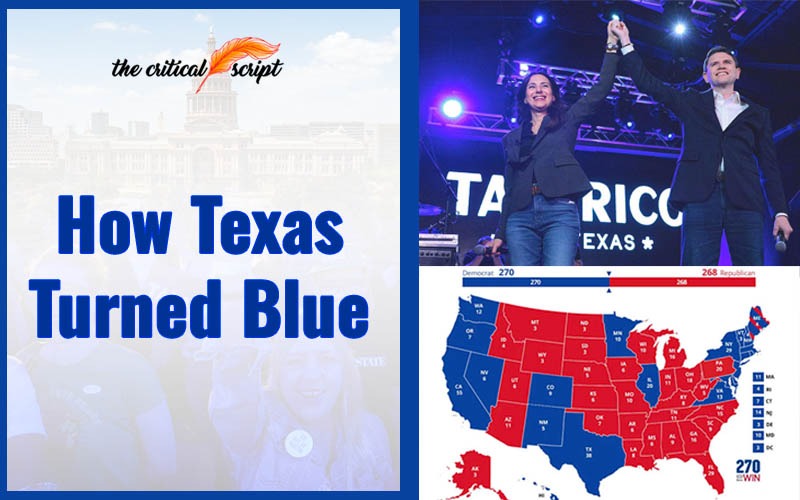
How texas turned blue
An impossible Democratic dream has finally come true
The Talarico-Paxton Senate race, a Republican miscalculation and the political earthquake Donald Trump could not prevent.
For decades, Texas was the Republican Party's fortress. A state so reliably red that Democrats could spend millions campaigning there and still struggle to make a dent. Winning Texas was the party's impossible dream. On November 3, 2026, that dream became reality.
Democrat James Talarico defeated Republican Ken Paxton in the US Senate race, ending a 38-year Democratic drought in Texas Senate elections. In a state Donald Trump carried comfortably in 2024, the result represents one of the most consequential political setbacks for Republicans in recent memory.
But how did it happen?
The answer begins with a Republican miscalculation.
Trump's gamble on Paxton
Republicans had a potentially safer option in four-term Senator John Cornyn, a seasoned political establishment figure. Instead, Donald Trump threw his weight behind Texas Attorney General Ken Paxton, a controversial Trump loyalist whose political career has been dogged by legal troubles and allegations of misconduct.
Paxton's 2023 impeachment by the Republican-controlled Texas House, followed by his acquittal in the state Senate, remained a significant political liability. His securities fraud case and other controversies provided Democrats with ample ammunition.
Trump's intervention helped Paxton secure the Republican nomination, but it also handed Democrats precisely the candidate they wanted to run against.
The Talarico factor
James Talarico was no conventional Democratic candidate. A former public school teacher, Presbyterian seminarian and state representative, he built his campaign around affordability, public education, corruption and economic fairness.
Crucially, he understood that winning Texas required more than mobilising Democrats in Austin, Houston and Dallas. He needed suburban voters, independents, younger Texans and Latino communities that Republicans had increasingly managed to attract.
His campaign also challenged the Republican assumption that faith and conservative cultural identity belonged exclusively to the GOP. Talarico presented a politics rooted in Christian values, compassion and economic justice, making an appeal that extended beyond traditional Democratic constituencies.
Money couldn't buy Texas
The financial scale of this contest was extraordinary. The Texas Senate race became the most expensive non-presidential election contest in American history, with approximately $573 million in advertising expenditure, according to AdImpact figures reported ahead of Election Day.
Elon Musk and Republican-aligned political groups poured substantial resources into supporting Paxton and countering Talarico. Yet the outcome offered a rather uncomfortable lesson for the Republican establishment: money can buy airtime, but it cannot guarantee votes.
Even the world's richest political benefactor could not purchase the result his preferred candidate needed.
A warning for Trump and the GOP
The Texas result cannot be viewed in isolation. It reflects growing concerns about affordability, economic insecurity and dissatisfaction with the direction of the country under Trump's administration.
Republicans also appear to have overestimated the durability of their gains among Latino voters, particularly in South Texas. Talarico's outreach demonstrated that these voters cannot be treated as a permanent Republican constituency.
The accompanying Democratic victory in the gubernatorial race, with Gina Hinojosa defeating Greg Abbott, makes the setback even more significant.
Does this mean Texas has permanently turned blue? Not necessarily. The state remains politically diverse, and Republicans retain a formidable electoral base.
But something fundamental has changed.
For decades, Democrats were told Texas was unwinnable. Republicans, meanwhile, treated its electoral loyalty as an entitlement. November 3 exposed the danger of that complacency.
Texas did not turn blue overnight. Its political landscape had been shifting for years. What happened this election was that those shifts finally translated into power.
And perhaps the most uncomfortable question for Donald Trump is this: if Republicans can lose Texas, what exactly remains beyond their reach
Disclaimer: The opinions expressed in this article are those of the author's. They do not purport to reflect the opinions or views of The Critical Script or its editor.
International Related Posts













Newsletter!!!
Subscribe to our weekly Newsletter and stay tuned.
Related Comments