


 INDIA ASIAN GAMES MEDAL MONITOR
·
India: 🥇 0
| 🥈 0
| 🥉 0
| Total: 0
INDIA ASIAN GAMES MEDAL MONITOR
·
India: 🥇 0
| 🥈 0
| 🥉 0
| Total: 0
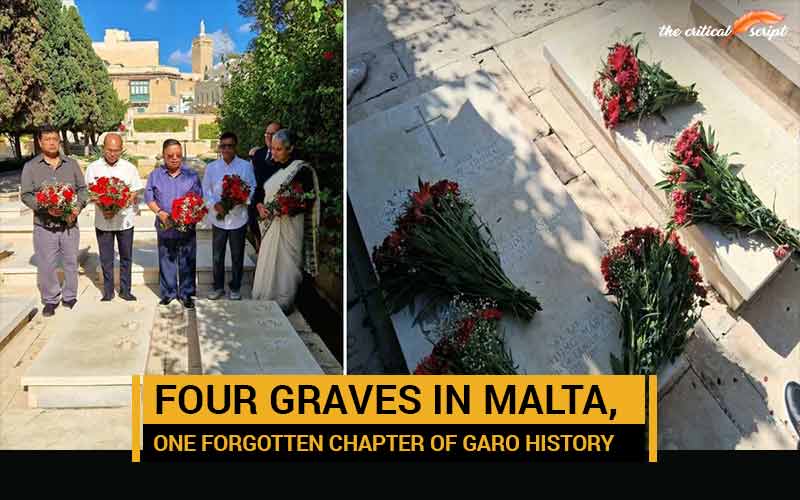
Four Graves in Malta, One Forgotten Chapter of Garo History
More than a century after the First
World War, four names from the Garo Hills have once again entered public memory
not on a battlefield in Europe, but from a military cemetery in Malta. Ading Marak,
Join Marak, Khew Marak and Sangjim Sangma died in June 1918 and were buried at
Pieta Military Cemetery, thousands of kilometres from the hills they had called
home. Their graves became the focus of renewed attention after a Meghalaya
Assembly delegation visited the cemetery in September 2026.
The story, however, is more
complicated than the recent headlines suggesting that three graves were
“discovered” for the first time. The Meghalaya delegation identified the three
additional graves during its visit, at a time when Khew Marak's grave was
understood to be the only known Garo grave at the cemetery. But historical and
photographic records show that the graves of Ading Marak, Join Marak and
Sangjim Sangma had been recorded before, including photographs dating back to
2014. Their names also appear in existing casualty databases. What the 2026
visit did was bring these individual graves back into public attention and
reconnect them with the history of Meghalaya and the Garo community.
That distinction matters because the
real story is not simply about the finding of three graves. It is about how men
from a relatively remote part of the Indian subcontinent became part of a
conflict that was consuming Europe, why they travelled thousands of kilometres
from the Garo Hills, what work they performed, and how some of them eventually
came to rest on a Mediterranean island.
From the Garo Hills to the First World War
In 1917, the British Indian
government was expanding its use of labour units to support the Allied war
effort. Modern wars required enormous logistical networks. Roads had to be
constructed and repaired, timber moved, supplies transported, equipment
salvaged and military infrastructure maintained. The work was physically
demanding and could take place close enough to the front to expose labourers to
the dangers of war.
The Garo Hills became part of this
mobilisation. In April 1917, around 1,000 men were recruited from different
parts of the Garo Hills following a call for enlistment. They formed what became
the 69th Garo Labour Company. The men were assembled at Tura and remained there
for several months while preparations were made for their overseas deployment.
The journey itself was enormous.
Contemporary historical accounts describe the men travelling from the hills
through the Indian subcontinent and across the Indian Ocean, the Red Sea and
the Mediterranean before reaching Europe. Disease took a toll even before they
reached France. According to one historical account, only about 500 of those
initially recruited were considered fit to proceed to France, with
approximately 456 eventually reaching the Western Front.
It is important to understand that
these men were labourers rather than conventional infantry soldiers. Their
contribution was largely logistical. The 69th Garo Labour Company supported
Allied operations through tasks including road construction, transportation of
supplies and other forms of manual work essential to keeping military
operations functioning.
That distinction does not make their
wartime experience less significant. In a conflict on the scale of the First
World War, armies could not function without the vast network of workers
operating behind and around the fighting forces.
Why were Garo labourers needed in Europe?
The First World War had become a war
of industrial scale. Millions of soldiers required food, ammunition, clothing,
fuel, timber and medical supplies. Roads and railways had to be built and
maintained. Goods had to be unloaded, transported and stored. Damaged infrastructure
had to be repaired.
The Indian Labour Corps became an
important part of this system. Labour units from different parts of British
India were deployed overseas, including in France. The Garo company was one
part of a much larger mobilisation of Indian labour during the war.
The recruitment process also needs
to be viewed within the realities of British colonial rule. It would be
misleading to reduce the experience to a simple story of men freely
volunteering for adventure overseas. Recruitment involved government officials,
local intermediaries, incentives and colonial administrative structures. At the
same time, the individual reasons of particular recruits remain difficult to
reconstruct. Economic opportunity, community circumstances, expectations of service
and the pressures of colonial recruitment could all have played a role, but
historians should be cautious about assigning motivations to men for whom
personal records are limited.
From France to Malta
The four graves in Malta raise
another obvious question: if the Garo Labour Company served in France, why did
these men die and get buried in Malta?
The answer lies in Malta's role
during the First World War.
The island became one of the British
Empire's major medical centres in the Mediterranean and earned the nickname
“Nurse of the Mediterranean.” Wounded and sick personnel from different
theatres of war were brought there for treatment.
This included members of Indian
Labour Corps units. Research on India-Malta relations records that members of
the 69th Garo Labour Company were among the Indian personnel connected with
Malta. Labourers who became casualties could be sent to Malta for medical
treatment, and those who died there were buried on the island or, depending on
religious practice, cremated.
Khew Marak's case provides a
particularly clear example. Records indicate that he served with the 69th Garo
Labour Company in France before being invalided to Malta, where he died on June
15, 1918. His grave remains at Pieta Military Cemetery.
The presence of a Garo grave in
Malta therefore does not mean that the man fought a battle on the island. For
these labourers, Malta could represent the final stage of a much longer journey
through wartime service, illness or injury and hospitalisation.
Four names, four deaths
The four Garo men now being
remembered at Pieta are:
●
Ading Marak — died June 10, 1918
●
Join Marak — died June 10, 1918
●
Khew Marak — died June 15, 1918
●
Sangjim Sangma — died June 19, 1918
All four died within a period of
just ten days.
That proximity is striking, but it
is important not to assume that all four died from the same illness or under
the same circumstances. The available records establish their names, service
and dates of death, but further archival research would be required to
determine their individual causes of death and reconstruct their final days.
There is a temptation, particularly with historical stories, to fill gaps in the record with assumptions. But sometimes the most honest historical account is to acknowledge what is known and what remains unknown.For these four men, their names survived. Much of the rest of their individual stories did not.
Why are some of the graves shared?
Another unusual feature of the
cemetery is that several names appear together on grave markers.
Malta's geology influenced its
wartime burial practices. The island has shallow soil and underlying rock,
which contributed to the use of joint and collective burials. Existing
photographic records show Khew Marak and Join Marak listed together at one grave
location, while Ading Marak and Sangjim Sangma are recorded at another,
alongside men from other wartime units.
In a sense, these shared graves
mirror the international character of the First World War itself. Men from
different regions, communities and units, brought together by a conflict
thousands of kilometres from their homes, ended up sharing the same final
resting place.
Garo memory did not disappear
It would also be inaccurate to
describe the Garo Labour Corps as completely forgotten.
The Garo community has continued to
remember its wartime contribution. July 16 is observed as Garo Labour Corps
Day, marking the return of surviving members to Tura in 1918. A cenotaph in
Tura commemorates members of the corps, and the history of the unit has remained
part of local remembrance.
What had faded from wider public
knowledge was the connection between the collective history of the Garo Labour
Corps and the individual overseas graves of men such as Ading, Join, Khew and
Sangjim.
That is an important difference. A
community can remember its ancestors collectively while still lacking a
complete account of where individual members lived, served, died and were
buried.
The history that remains to be recovered
The Malta visit therefore opens a
larger historical question.
Who were these four men before they
became names on military grave markers? Which villages did they come from? Who
were their parents, wives, children or siblings? What made them join the Labour
Company? What did they experience during their journey to Europe? What happened
to their families after they failed to return?
The answers may still exist in
fragments—in recruitment documents, military records, church registers, village
histories, family papers, photographs and oral traditions.
Research into the Garo Labour Corps
can potentially bring these fragments together. The objective should not merely
be to add names to a list, but to restore individual lives to a history that
has often reduced them to numbers and casualty figures.
The story of the 69th Garo Labour
Company also deserves to be placed within the larger history of India's
contribution to the First World War. Men from the hills of present-day
Meghalaya became part of a global conflict through a colonial system that
transported labour, resources and soldiers across continents. Their work was
not always visible in the official narratives of battle, but wars are sustained
not only by those who fight at the front, but also by those who build roads,
move supplies, handle materials and keep the machinery of war functioning.
More than a century later, four
names on a cemetery wall in Malta provide a tangible link between the Garo
Hills and that global history.
Ading Marak. Join Marak. Khew Marak.
Sangjim Sangma.
Their graves were far from home.
Their history, however, belongs to home as much as it belongs to the wider
story of the First World War. The task now is to go beyond the graves - to
recover the lives behind the names, and to ensure that the next generation
knows why four men from the Garo Hills came to rest on a small Mediterranean
island.
Disclaimer: The opinions expressed in this article are those of the author's. They do not purport to reflect the opinions or views of The Critical Script or its editor.
History And Facts Related Posts






Newsletter!!!
Subscribe to our weekly Newsletter and stay tuned.
Related Comments