


 INDIA ASIAN GAMES MEDAL MONITOR
·
India: 🥇 0
| 🥈 0
| 🥉 0
| Total: 0
INDIA ASIAN GAMES MEDAL MONITOR
·
India: 🥇 0
| 🥈 0
| 🥉 0
| Total: 0
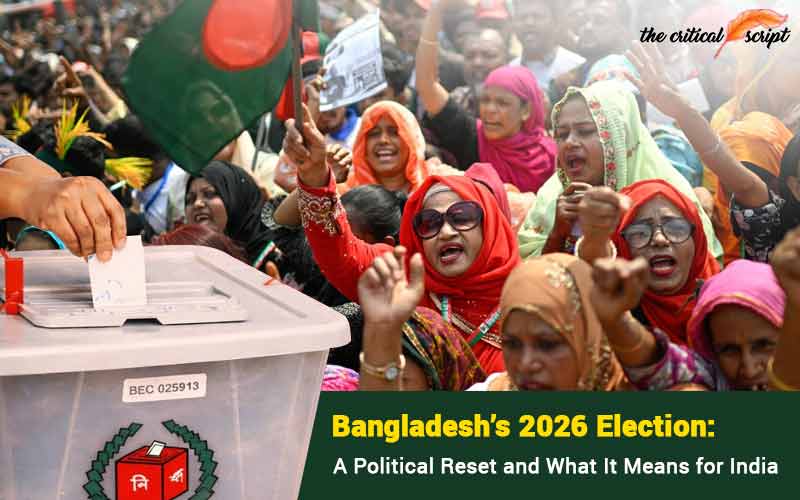
Bangladesh’s 2026 Election: A Political Reset and What It Means for India
Bangladesh’s 2026 general election marks one of the most consequential political transitions in South Asia in recent years. The decisive victory of the Bangladesh Nationalist Party (BNP) under the leadership of Tarique Rahman signals a dramatic return to power after nearly two decades in opposition. The election, the first since the political upheaval of 2024, reshapes Bangladesh’s internal governance landscape and recalibrates regional geopolitics, particularly for India.
The implications extend well beyond Dhaka.
A Transformative Election
The 2026 polls were held in the aftermath of the 2024 mass uprising that ended the prolonged rule of the Awami League government led by Sheikh Hasina. The uprising, largely youth-driven, altered the political balance, opening space for opposition forces and constitutional reform.
With a commanding parliamentary majority, the BNP has returned to power on a platform promising governance reforms, economic revival, and institutional restructuring. The party has proposed constitutional amendments, enhanced parliamentary oversight mechanisms, and expanded social welfare programmes aimed at addressing unemployment and inflation.
The scale of its victory suggests voter fatigue with prolonged political dominance by a single party and a demand for structural recalibration.
Yet, electoral success alone does not guarantee stability.
Governance Promises vs. Political Realities
The BNP has outlined an ambitious reform agenda focused on strengthening democratic institutions, revisiting key constitutional provisions, expanding public health and education spending, accelerating growth in the ICT sector, and revitalizing industrial investment to stimulate economic recovery.
However, Bangladesh’s political history remains marked by deep polarisation between the BNP and Awami League camps. Sustained governance will depend on whether the BNP can move beyond adversarial politics and maintain inclusive statecraft.
Another significant factor is the parliamentary presence of the Bangladesh Jamaat-e-Islami, which has re-emerged as a visible opposition force. Its performance in the elections reflects shifting political alignments, but it also raises questions about ideological balance and secular governance - issues closely watched domestically and internationally.
For Bangladesh, the immediate test is institutional stability: ensuring that electoral change translates into administrative continuity, economic confidence, and rule-of-law credibility.
The Economic Dimension: Stability or Uncertainty?
Bangladesh’s economic trajectory over the past decade has been characterized by steady GDP growth, a strong garment export sector, and expanding infrastructure investments. However, inflationary pressures, currency strain, and global supply chain disruptions have posed challenges.
The BNP has promised business-friendly regulatory reforms, measures to facilitate foreign investment, expansion of the digital economy, and targeted initiatives aimed at generating employment opportunities for the country’s youth.
If implemented effectively, these measures could restore investor confidence. However, political transition periods often trigger market caution. International investors will be watching how smoothly power consolidates and whether policy continuity is maintained.
For India, this matters significantly.
What the Election Means for India
India and Bangladesh share a 4,096-kilometre border, deep cultural ties, extensive trade links, and growing strategic interdependence. Bangladesh is India’s largest trade partner in South Asia and a critical partner in regional connectivity initiatives.
1. Diplomatic Reset
Prime Minister Narendra Modi has already congratulated Tarique Rahman, signalling India’s readiness to engage constructively with the new government. Yet relations between New Delhi and Dhaka under BNP rule have historically been more cautious compared to the warmth seen during Awami League leadership.
India’s approach is likely to be pragmatic: maintaining engagement without overt political positioning. Stability in Dhaka is in India’s strategic interest.
2. Security and Border Management
One of the most significant gains in India-Bangladesh relations over the past decade has been security cooperation, particularly in curbing insurgent activity affecting India’s Northeastern states.
Any dilution of this cooperation would have implications for Assam, Tripura, Meghalaya, and other bordering states. Conversely, continued joint counter-terrorism and intelligence coordination would reinforce regional stability.
The BNP government’s stance on cross-border militancy and border management will therefore be closely monitored in New Delhi.
3. Connectivity and the Northeast
Bangladesh plays a central role in India’s Act East Policy. Transit routes through Bangladeshi ports and rail corridors significantly reduce logistical costs for India’s Northeast.
Political stability in Dhaka ensures continuity of these arrangements. Any policy shifts or renegotiations could affect trade flows and connectivity projects.
For India’s Northeast, especially states like Assam, Tripura, and Arunachal Pradesh, smooth Bangladesh relations are economically vital.
4. Geopolitical Balance and China Factor
Bangladesh has increasingly attracted infrastructure and investment interest from China. Under a new government, foreign policy recalibration is possible.
India will be attentive to whether Dhaka tilts further towards Beijing in infrastructure, defence procurement, or strategic alignment. South Asia remains a competitive geopolitical theatre, and Bangladesh occupies a critical node.
That said, Bangladesh has historically pursued multi-vector diplomacy. The BNP may seek balanced engagement with both India and China rather than exclusive alignment.
5. Minority Rights and Domestic Stability
India has consistently expressed interest in the welfare of minority communities in Bangladesh. Any communal tension or internal unrest could spill over diplomatically and politically.
Stable governance that protects minority rights and sustains social harmony will reinforce bilateral trust.
Risks Ahead
Despite securing a decisive electoral mandate, the BNP government faces significant challenges, including deep political polarisation, economic volatility during the transition period, potential institutional resistance to rapid reforms, mounting regional geopolitical pressures, and internal ideological tensions among coalition partners.
Bangladesh’s democratic institutions will be tested in the coming months.
A Moment of Opportunity and Caution
The 2026 election is more than a political victory for the BNP; it represents a structural reset in Bangladesh’s democratic evolution. Whether it leads to sustainable reform or renewed instability will depend on governance choices made in the next year.
For India, the priority is clear: support stability, deepen economic ties, and maintain strategic cooperation without interfering in domestic politics.
Bangladesh’s political shift does not automatically alter the fundamentals of bilateral engagement - geography, trade interdependence, and security cooperation bind the two nations.
But it does require recalibration.
In South Asia’s fluid political landscape, Bangladesh remains central. Its stability strengthens the region. Its instability complicates it.
The 2026 election has opened a new chapter.
How it is written will shape not only Bangladesh’s future, but the broader strategic balance of the subcontinent.
Disclaimer: The opinions expressed in this article are those of the author's. They do not purport to reflect the opinions or views of The Critical Script or its editor.
Politics Related Posts







Newsletter!!!
Subscribe to our weekly Newsletter and stay tuned.
Related Comments