


 INDIA ASIAN GAMES MEDAL MONITOR
·
India: 🥇 0
| 🥈 0
| 🥉 0
| Total: 0
INDIA ASIAN GAMES MEDAL MONITOR
·
India: 🥇 0
| 🥈 0
| 🥉 0
| Total: 0
Rath Yatra: The Journey That Unites a Nation
From the Sacred Streets of Puri to the Hills of Manipur, the Chariot Festival Continues to Evolve Across India
Every year, as the monsoon clouds gather over the eastern coast of India, millions of hands reach for thick ropes tied to towering wooden chariots. With chants of "Jai Jagannath!" echoing through the air, the colossal wheels begin to move, carrying not just the deities of Lord Jagannath, Lord Balabhadra and Devi Subhadra, but also more than a thousand years of living history.
The Rath Yatra, or the Festival of Chariots, is among the oldest continuously celebrated public religious festivals in the world. It is not confined to Odisha or even to India. Today, it is celebrated across continents, drawing devotees and curious visitors alike. Yet its essence remains unchanged: a symbolic journey in which the Divine steps out of the sanctum to be among the people.
A Tradition Rooted in Antiquity
The origins of Lord Jagannath are layered with mythology, tribal traditions and recorded history.
According to the Skanda Purana, King Indradyumna of Malwa dreamt of Nila Madhava, a mysterious form of Lord Vishnu worshipped by the indigenous Sabara tribe in the forests of present-day Odisha. After a long search, the deity disappeared, and the king was instructed through a divine revelation to carve new images from a sacred log of wood that floated ashore.
Legend says the divine architect Vishwakarma agreed to carve the idols on one condition, that he would work in complete seclusion and not be disturbed. Unable to resist curiosity, the king opened the workshop before the work was complete. Vishwakarma vanished, leaving behind the now-iconic unfinished wooden forms of Jagannath, Balabhadra and Subhadra. Those distinctive large eyes, rounded faces and incomplete limbs have since become one of Hinduism's most recognisable artistic traditions.
While mythology provides the spiritual narrative, historians see Jagannath worship as a remarkable synthesis of tribal beliefs, Buddhism, Shaivism, Shaktism and Vaishnavism, making the deity one of India's most inclusive religious symbols.
The Temple That Shaped a Civilization
The present-day Jagannath Temple in Puri was commissioned in the 12th century by King Anantavarman Chodaganga Deva of the Eastern Ganga dynasty and later expanded by his successors. Over the centuries, it evolved into one of Hinduism's four sacred pilgrimage sites, the Char Dham, alongside Badrinath, Dwarka and Rameswaram.
The temple also became the heart of Odisha's social, cultural and economic life. Its rituals, architecture, music, cuisine and festivals influenced generations of artists, poets and pilgrims.
Among all its ceremonies, none captured the imagination of the people quite like Rath Yatra.
Why Does Lord Jagannath Leave the Temple?
Unlike most Hindu festivals where devotees visit the deity, Rath Yatra reverses the relationship.
Once every year, Lord Jagannath, accompanied by his elder brother Lord Balabhadra and sister Devi Subhadra, leaves the sanctum sanctorum and travels nearly three kilometres from the Jagannath Temple to the Gundicha Temple, believed to be the home of his maternal aunt.
The journey symbolises the accessibility of the Divine. It is believed that Lord Jagannath comes out to bless everyone, including those who cannot enter the temple. The festival embodies a powerful social message: before God, there is no distinction of caste, status or wealth.
This spirit is reflected in one of the festival's most enduring rituals, the Chhera Pahanra. Before the chariots begin their journey, the Gajapati Maharaja of Puri, once the sovereign ruler of Odisha, ceremonially sweeps the platforms of the chariots with a golden broom. The act is a profound reminder that even a king is but a humble servant before the Almighty.
The Three Chariots
Every year, three new chariots are painstakingly constructed from specially selected timber using traditional techniques passed down through hereditary artisan families.
Each chariot has its own name, colours and symbolism:
Nandighosha – Lord Jagannath's chariot with sixteen wheels.
Taladhwaja – Lord Balabhadra's chariot with fourteen wheels.
Darpadalana (Devadalana) – Devi Subhadra's chariot with twelve wheels.
The construction itself is regarded as a sacred ritual, beginning months before the festival.
From Puri to the World
Although Puri remains the spiritual centre of Rath Yatra, the festival gradually spread across the Indian subcontinent through trade, pilgrimage, royal patronage and the Bhakti movement.
Every region embraced Jagannath in its own distinctive way.
Mahesh Rath Yatra: Bengal's Living Legacy
In Mahesh, near Serampore in West Bengal's Hooghly district, Rath Yatra has been celebrated since 1396 CE, making it one of India's oldest surviving chariot festivals after Puri.
Founded by Dhrubananda Brahmachari, the Mahesh Rath Yatra became an important centre of Jagannath devotion in Bengal. Over centuries, poets, saints and reformers, including Sri Ramakrishna Paramahamsa, visited the festival.
Its towering wooden chariot, rebuilt periodically while preserving its traditional design, remains one of Bengal's most iconic religious symbols.
Today, Kolkata and the ISKCON headquarters at Mayapur have further expanded the festival's reach, drawing thousands of devotees every year.
Kang Chingba: Manipur's Royal Chariot Festival
Few people realise that Manipur has one of India's oldest and most distinctive Rath Yatra traditions.
Here, the festival is known as Kang or Kang Chingba, a term derived from the Manipuri word for chariot.
Jagannath worship reached Manipur during the reign of Meidingu Charairongba (1697–1709). However, the festival assumed its present form under Maharaja Bhagyachandra, one of Manipur's greatest Vaishnavite rulers.
After returning from exile around 1779–1780, Bhagyachandra introduced the royal celebration of Kang, inspired by the Jagannath tradition of Puri while adapting it to Manipuri culture.
The festival was later revived and popularised as a public celebration by Maharaja Gambhir Singh in 1832, following the reconstruction of the Shree Govindajee Temple after the Burmese occupation.
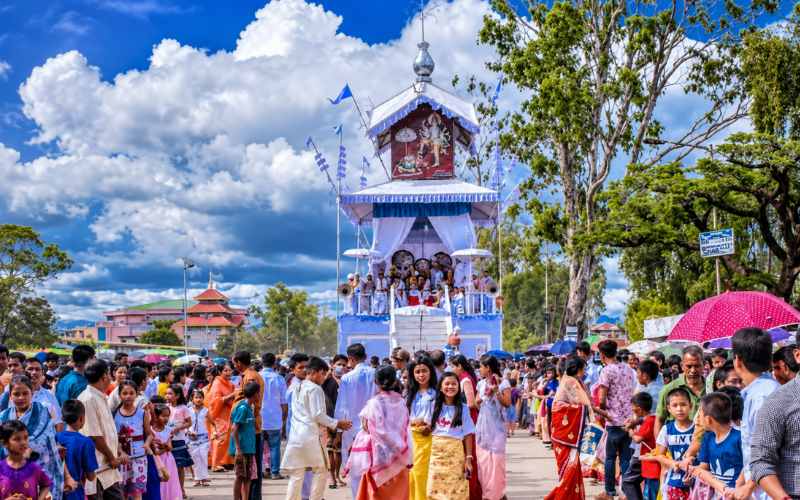
Unlike the towering chariots of Puri, Manipur's Kang features beautifully carved wooden chariots pulled through neighbourhoods accompanied by Sankirtana, Pung Cholom drummers, devotional dance and community feasts.
The return procession, known locally as Kanglen, marks the conclusion of the festival after about ten days.
Today, Kang remains one of Manipur's most important religious and cultural celebrations, reflecting the unique synthesis of Vaishnavism and indigenous Meitei traditions.
Assam and the Northeast
Across Assam, Rath Yatra is celebrated in Jagannath temples and Vaishnavite centres in Guwahati, Barpeta, Nagaon, Dibrugarh, Silchar, Tinsukia and many other towns.
Influenced by both Odisha's Jagannath tradition and the Neo-Vaishnavite movement initiated by Srimanta Sankardeva, the festival combines colourful processions, devotional music, kirtans and community feasts.
In recent years, several temples in Assam have adopted the Puri tradition of separate chariots for Lord Jagannath, Balabhadra and Subhadra.
Elsewhere in the Northeast, including Tripura, Arunachal Pradesh, Nagaland and Meghalaya, Rath Yatra is celebrated by local Jagannath temples and ISKCON communities. Though smaller in scale, these celebrations highlight the growing cultural footprint of the festival across the region while reflecting local traditions and community participation.
Gujarat's Grand Procession
Ahmedabad's Jagannath Rath Yatra, first organised in 1878, has become one of western India's largest religious processions, featuring decorated elephants, akhadas, devotional tableaux and thousands of devotees.
A Festival Without Borders
The global journey of Rath Yatra began in the late 1960s through the efforts of A.C. Bhaktivedanta Swami Prabhupada, founder of the International Society for Krishna Consciousness (ISKCON).
Inspired by the Puri tradition, ISKCON organised the first overseas Rath Yatra in San Francisco in 1967. Today, similar festivals take place annually in London, New York, Toronto, Paris, Sydney, Moscow, Johannesburg, Singapore and dozens of other cities, drawing participants from diverse faiths and cultures.
More Than a Religious Festival
For scholars, Rath Yatra represents a remarkable continuity of India's civilisational traditions. For devotees, it is a celebration of divine grace. For historians, it illustrates how religious practices adapt while preserving their essential spirit.
Across centuries, kingdoms have risen and fallen, empires have disappeared, and societies have transformed. Yet every Ashadha, the wheels of Jagannath's chariot continue to turn.
Perhaps that is the festival's greatest lesson.
It reminds us that faith is not static. It moves among people, embraces diversity, crosses regions and generations, and continually renews itself.
From the sacred streets of Puri to the royal avenues of Imphal, from the centuries-old traditions of Mahesh to the growing celebrations across Northeast India and the world, Rath Yatra remains a living testament to India's extraordinary cultural continuity - a journey where history, devotion and community travel together.
Jai Jagannath.
Disclaimer: The opinions expressed in this article are those of the author's. They do not purport to reflect the opinions or views of The Critical Script or its editor.
Beliefs And Myths Related Posts






Newsletter!!!
Subscribe to our weekly Newsletter and stay tuned.
Related Comments