


 INDIA ASIAN GAMES MEDAL MONITOR
·
India: 🥇 0
| 🥈 0
| 🥉 0
| Total: 0
INDIA ASIAN GAMES MEDAL MONITOR
·
India: 🥇 0
| 🥈 0
| 🥉 0
| Total: 0
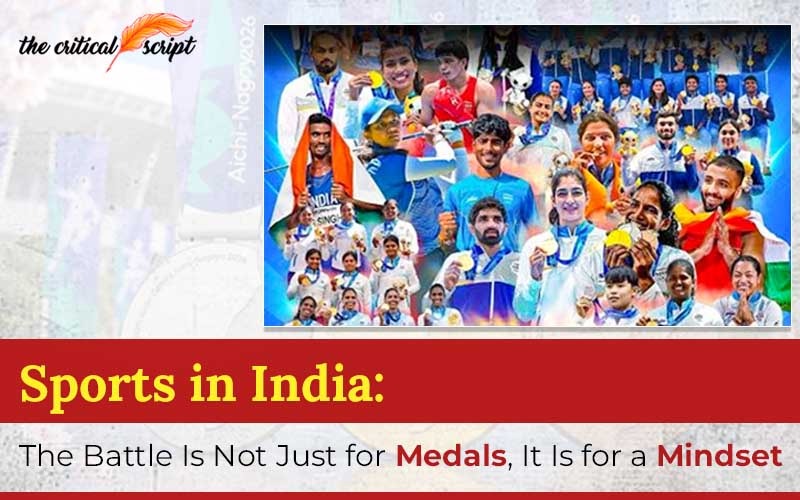
Sports in India: The Battle Is Not Just for Medals, It Is for a Mindset
Let us not look at sports in India only through the size of our population. Instead, look at the number of people who actually enter the organised sporting ecosystem.
South Korea, for instance, has around 401,141 registered athletes, while India has 604,952+ athlete registrations on the National Sports Repository System (NSRS). At first glance, India's number may appear considerably higher. But when these figures are viewed against the respective populations, the picture changes dramatically. The registered athletes represent roughly 0.78% of South Korea's population compared to around 0.04% of India's population. In other words, the proportion of the population entering the organised sporting system is vastly different.
And that is the point I am trying to make.
South Korea has a strong sporting culture. India, by and large, does not. We have long been taught a very different philosophy: “Kheloge kudoge hoge kharab, padhoge likhoge banoge nawab.”
The message was drilled into generations of Indian children. If you played, you were wasting your time. If you studied, you were building your future. Sports were something you could do after school, during your free time or simply for recreation, but very rarely were they presented as a serious career opation.
There have, of course, been exceptions. Cricket is the biggest one.
Cricket managed to break through this mindset because it offered something that very few other sports could offer - visibility, celebrity, money and a recognisable career path. A child could watch a cricketer on television, see the crowds, understand the opportunities available and dream of becoming one. Parents, who may once have discouraged their children from playing sport, began encouraging cricket because they could see that it could actually become a profession even if you don't represent India.
The same transformation has not happened across Indian sport.
That is why India's performance at the 2026 Asian Games deserves considerable appreciation.
India finished fourth overall, winning 85 medals - 21 gold, 27 silver and 37 bronze. We finished behind the sporting powerhouses of China, Japan and South Korea, while staying ahead of a number of other strong sporting nations.
That is a commendable result. And yet, I believe we should look at it from two different perspectives. The first is celebration and the second is introspection.
For a country that has historically not placed sport on the same pedestal as education or conventional professions, reaching fourth in Asia, in a region containing sporting behemoths such as China, South Korea, Japan, Iran and Kazakhstan, is no small achievement.
But if we want to move from being a country that produces exceptional athletes to becoming a sporting nation, we have to quickly turn these achievements into an overall trend. We cannot keep relying on a few states and communities to produce most of India's sporting talent.
For far too long, some of our strongest sporting pipelines have come from places such as Manipur, Kerala, Punjab and Haryana. These states and communities have produced generations of athletes because sport has become part of their social and cultural fabric. Children grow up seeing athletes around them. They have local heroes. They have sporting traditions. Families are more willing to let their children pursue sport.
We need to replicate that culture across India.
A child in Assam, Arunachal Pradesh, Meghalaya, Nagaland, Mizoram, Tripura, Odisha, Bihar, Uttar Pradesh, Rajasthan, Madhya Pradesh, Tamil Nadu or any other part of India should be able to look at a successful athlete and believe that this too can be a career.
The talent is not restricted to four or five states. What is restricted is opportunity, exposure, infrastructure, coaching, encouragement and, most importantly, the mindset around sport.
And this is where the Asian Games performance becomes important.
The medals tell us that Indian talent exists. The performances tell us that Indian athletes can compete with the best in Asia. The breakthroughs across different disciplines tell us that we are no longer entirely dependent on cricket or a handful of traditional Olympic sports.
But 85 medals should not become the ceiling. It should become the starting point.
We need more children entering sport. We need more parents willing to support them. We need schools that treat physical education seriously. We need better sporting infrastructure at the district and grassroots levels. We need coaches, sports scientists, nutritionists and physiotherapists to become part of the sporting ecosystem. We need competitions that give young athletes a pathway from school and district level all the way to the national and international stage.
Most importantly, we need to make sport aspirational. Cricket has already shown us how this can happen.
Its fame and money have done something incredibly important: they have changed the Indian parents' perception of sport. A parent who once said, “Don't waste your time playing cricket; concentrate on your studies,” can now say, “If you are good enough, you can make a career out of it.”
That psychological transformation is perhaps cricket's greatest contribution to Indian sport. Now the rest of Indian sport needs to follow.
Boxing needs its Virat Kohli moment. Wrestling needs its cricket-like visibility. Athletics needs its household names. Shooting, archery, badminton, swimming, gymnastics, weightlifting, hockey and dozens of other disciplines need to become sports that children can dream about, and parents can take seriously.
Because ultimately, the battle is not merely for medals. It is a battle for mindset.
India has made a good start. Finishing fourth in the Asian Games, despite being surrounded by some of the strongest sporting nations in the world, is something we should recognise and celebrate.
But the road ahead is very long. We are not simply trying to improve India's medal tally. We are trying to change how an entire society thinks about sport.
From “Kheloge kudoge hoge kharab” to “Kheloge kudoge, desh ka naam karoge.” That change will not happen overnight. It will take years of investment, better systems, stronger grassroots programmes, and thousands of athletes who become role models for the next generation.
It is a good start but a very hard and very long way to go. Because this time, the opponent is not China, Japan or South Korea.
The mindset itself is the opponent.
Disclaimer: The opinions expressed in this article are those of the author's. They do not purport to reflect the opinions or views of The Critical Script or its editor.
Sports Related Posts




Newsletter!!!
Subscribe to our weekly Newsletter and stay tuned.
Related Comments