


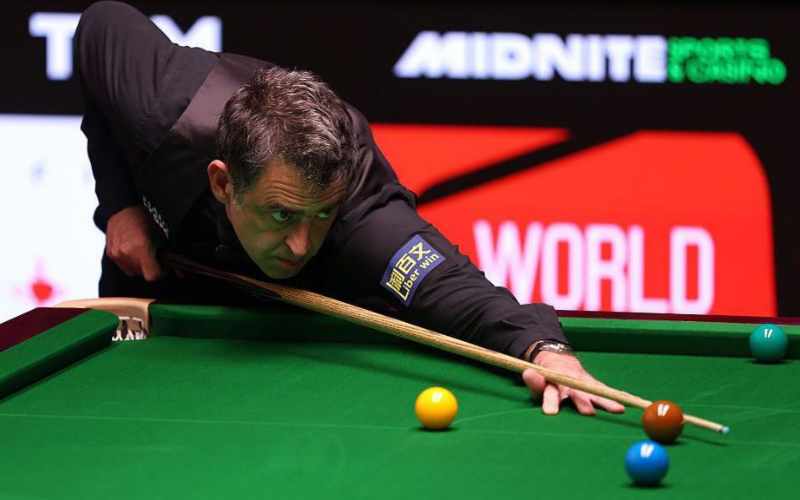
China’s Snooker Surge Is Redefining a Traditionally British Game
For much of its modern history, snooker has been synonymous with the United Kingdom, its crucible, its culture, and its champions. But that long-standing dominance is no longer assured. A quiet but decisive shift is underway, and its epicentre lies thousands of miles away in China.
China will be represented by 11 players at the World Snooker Championship this year, breaking the previous record for Chinese players reaching the Crucible.
The scale of that shift is increasingly difficult to ignore. Chinese players are no longer fringe contenders; they are now a formidable collective presence on the sport’s biggest stages. Whether or not the exact number fluctuates year to year, the consistent rise in Chinese representation at the World Snooker Championship signals a deeper structural transformation.
At the heart of this movement is a generation shaped not just by talent, but by system. Trailblazers like Ding Junhui first ignited China’s passion for the game, proving that a player from outside the UK could compete and win at the highest level. That initial spark has since evolved into something far more powerful: a pipeline.
Today’s stars, including current World Champion Zhao Xintong and Wu Yize, represent a new breed that is fearless, technically refined, and unburdened by the weight of tradition. Around them is a growing cohort that includes Zhou Yuelong, Xiao Guodong, Zhang Anda, Pang Junxu, and Si Jiahui, each capable of deep runs in tournaments. This is not a golden generation; it is a sustained production line.
The contrast with the UK is becoming more pronounced. While Britain continues to produce promising talents such as Stan Moody, the pathway appears less cohesive. The sport still leans heavily on established names, with fewer young players breaking through at the very top level with consistency.
This divergence is rooted in structure. China has invested heavily in academies, coaching, and early talent identification, creating an ecosystem where young players are systematically developed and tested. The UK, by comparison, relies more on legacy systems that are rich in history but arguably slower to adapt to a more competitive global landscape.
What emerges is not a story of decline, but of evolution. Snooker is no longer a British preserve; it is becoming a genuinely international sport. In this transition, China is not just participating; it is setting the pace.
For over three decades, the “Class of ’92,” including Ronnie O'Sullivan, John Higgins, and Mark Williams, has carried British snooker on its shoulders. But even legends cannot hold back time, and unlike in the UK, China is no longer waiting for a new generation to arrive. It has already built one.
Mark Selby represents the next dominant generation after 1992, along with players like Judd Trump, Kyren Wilson, and Mark Allen. They are in their 30s and early 40s and remain in strong competitive shape, but even they are now facing pressure from younger players, especially from China.
The question is no longer whether China can challenge the UK’s dominance. It is whether the UK can reinvent itself quickly enough to keep up.
Disclaimer: The opinions expressed in this article are those of the author's. They do not purport to reflect the opinions or views of The Critical Script or its editor.
Sports Related Posts













Newsletter!!!
Subscribe to our weekly Newsletter and stay tuned.
Related Comments