


 INDIA ASIAN GAMES MEDAL MONITOR
·
India: 🥇 0
| 🥈 0
| 🥉 0
| Total: 0
INDIA ASIAN GAMES MEDAL MONITOR
·
India: 🥇 0
| 🥈 0
| 🥉 0
| Total: 0
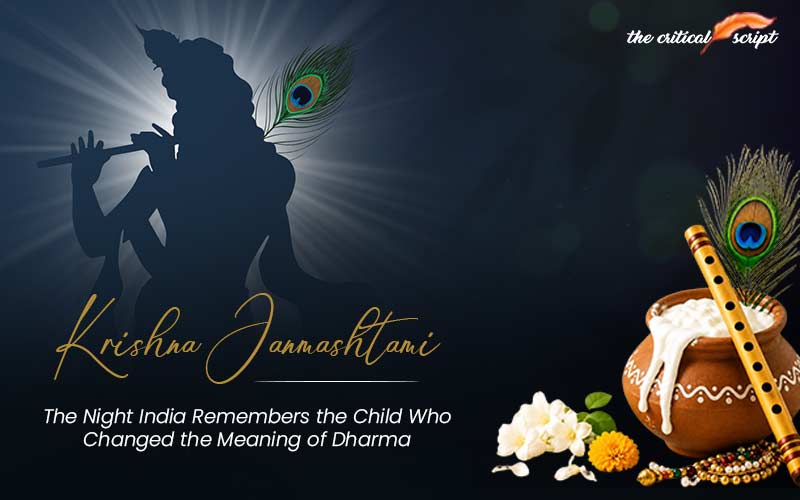
Krishna Janmashtami: The Night India Remembers the Child Who Changed the Meaning of Dharma
Across India, Krishna Janmashtami is celebrated as the birth of Lord Krishna, but its enduring significance lies far beyond the retelling of a divine birth. It is a festival that brings together mythology, philosophy, music, devotion, folk traditions, and the idea that righteousness can emerge from the most uncertain of circumstances. Every year, as temples and homes prepare for the midnight celebration, the story of Krishna returns not merely as an episode from the past, but as a living tradition through which generations have explored questions of duty, compassion, courage, love and the nature of good and evil.
According to Hindu tradition, Krishna was born at midnight on the eighth day, Ashtami, of the dark fortnight of the month of Bhadrapada. His birth took place in Mathura, where his parents, Devaki and Vasudeva, were imprisoned by Devaki's brother, the tyrannical King Kamsa. A prophecy had warned Kamsa that Devaki's eighth child would become the cause of his downfall, leading him to imprison the couple and kill their newborn children. Krishna's birth therefore takes place against a backdrop of fear and political oppression, making the celebration of his arrival inseparable from the larger theme of hope emerging in a time of darkness.
The traditional narrative describes the night of Krishna's birth as extraordinary, with the prison guards falling asleep and the restraints binding Vasudeva opening miraculously. Vasudeva then carried the infant Krishna across the Yamuna to Gokul, where he placed him in the care of Nanda and Yashoda. In return, he brought back their newborn daughter. This journey across the river has become one of the most enduring images associated with Janmashtami, symbolising the extraordinary lengths to which love, faith and duty may compel an individual to go in order to protect what is precious.
From a Divine Birth to a Human Childhood
What makes Krishna distinctive within India's religious imagination is that his story does not remain confined to the grandeur of divinity. Much of his appeal comes from the fact that he is remembered through childhood: as the mischievous Makhan Chor, the beloved child of Yashoda, the playful companion of the people of Gokul and the flute-playing figure associated with Vrindavan.
These stories gave Krishna an unusually intimate place in Indian devotional culture. The divine is not presented only as distant, powerful, or inaccessible; Krishna is also the child who steals butter, the son who tests his mother's patience, the friend who plays with other children, and the beloved whose flute draws people towards him. Through these stories, devotion became deeply personal, allowing generations of devotees to approach the divine through affection, friendship and love.
The famous stories of Krishna's childhood are preserved across several Hindu texts and traditions, including the Bhagavata Purana, Harivamsa and various later devotional works. While the narratives differ in detail and interpretation, together they have shaped one of the most recognisable religious and cultural traditions in India.
Why Krishna's Story Became More Than Mythology
Krishna's life occupies a unique position because it moves through several different roles. He is simultaneously remembered as a child of Gokul, a beloved figure of Vrindavan, a strategist and statesman, a protector of his people and, most importantly, the teacher of the Bhagavad Gita.
The transition from the playful Krishna of Vrindavan to the Krishna who stands beside Arjuna on the battlefield of Kurukshetra is one of the most profound transformations in Indian philosophical literature. In the Bhagavad Gita, Krishna addresses Arjuna's moral crisis and explains the importance of performing one's duty without becoming enslaved to the fruits of action. His teaching on dharma, karma, detachment, knowledge and devotion has influenced Indian philosophical thought for centuries and continues to be interpreted across religious and philosophical traditions.
This is perhaps why Janmashtami remains relevant even beyond its religious observance. Krishna's story is fundamentally concerned with navigating a complicated world rather than escaping from it. His teachings recognise that duty can be difficult, choices can be morally complex and righteousness may sometimes require courage rather than passivity.
The Midnight Celebration
The timing of Janmashtami carries its own symbolism. Devotees traditionally remain awake through the night, singing devotional songs, reciting scriptures and participating in prayers before celebrating Krishna's birth at midnight.
Temples are decorated with flowers, lights and images depicting episodes from Krishna's life, while devotees may observe fasting during the day before breaking it after the midnight birth ceremony. In many places, an idol or image of infant Krishna is placed in a decorated cradle, recalling the moment when Vasudeva brought the newborn child to safety.
The celebration varies enormously across India, reflecting the country's extraordinary regional diversity.
In Mathura and Vrindavan, where Krishna's life is traditionally associated with the landscape, Janmashtami is marked by elaborate temple ceremonies, devotional singing, processions and dramatic performances depicting episodes from Krishna's life. The surrounding Braj region becomes particularly vibrant as communities celebrate through music, dance and Ras Lila traditions.
In Maharashtra, Janmashtami is closely associated with Dahi Handi, in which teams form human pyramids to reach and break a pot suspended above the ground. The tradition draws upon stories of Krishna and his friends playfully stealing butter and curd from hanging pots, transforming a childhood story into a spectacular community celebration.
In Gujarat, particularly in regions associated with Krishna traditions and Dwarka, the festival is observed through temple worship, devotional gatherings and cultural programmes. In Odisha, Manipur, West Bengal, Assam and several other parts of the country, Krishna devotion has developed distinctive local expressions through music, dance, theatre and Vaishnavite traditions.
This regional variety is important because Janmashtami is not one single celebration repeated identically across India. It is a shared cultural idea continually interpreted through local languages, artistic traditions and community practices.
Krishna and India's Living Cultural Heritage
Few figures in Indian culture have travelled so extensively across artistic forms as Krishna. His presence can be found in classical music, folk songs, miniature paintings, sculpture, theatre, dance and literature.
The stories of Krishna and Radha, for instance, became central to several schools of Bhakti poetry, inspiring poets such as Surdas, Mirabai, Jayadeva and numerous regional devotional traditions. Classical dance forms including Manipuri, Kathak and Odissi have also incorporated narratives associated with Krishna, while countless folk traditions have adapted his stories to local cultural settings.
The result is a remarkable cultural phenomenon: Krishna is simultaneously a religious figure and a major subject of India's artistic imagination.
His flute, the peacock feather, the cows of Gokul, the banks of the Yamuna and the colours of Vrindavan have become visual and poetic symbols recognised far beyond the communities that worship him.
The Deeper Message of Janmashtami
At its heart, Janmashtami is a celebration of hope arriving in a world dominated by fear. Krishna's birth occurs under imprisonment, surveillance and the threat of violence, yet the narrative does not end with those circumstances. The child survives, grows and eventually confronts the very system that sought to destroy him.
That progression gives the festival a deeper meaning. It suggests that difficult circumstances do not necessarily determine the future and that the arrival of change can begin in the most unexpected form. Krishna's story repeatedly places him in situations where conventional expectations are challenged, whether as the mischievous child of Gokul, the protector of Mathura, the strategist of the Mahabharata or the philosophical guide of Arjuna.
The message of Janmashtami, therefore, is not simply that Krishna was born. It is that dharma can be restored, courage can emerge from adversity and hope can survive even when circumstances appear overwhelmingly dark.
A Festival That Continues to Evolve
Modern Janmashtami celebrations show how an ancient tradition can remain alive without remaining frozen in time. Alongside temple rituals and traditional observances, communities organise cultural programmes, devotional concerts, children's performances, exhibitions and public celebrations. Families introduce children to stories of Krishna through illustrated books, theatre, music and storytelling, ensuring that the tradition continues through new generations.
Yet beneath the lights, decorations and celebrations remains the central story: a child born in captivity who was carried across a river to safety, grew up among ordinary people and eventually became one of the most influential figures in India's religious and philosophical heritage.
That is what makes Krishna Janmashtami more than a commemoration of a birth. It is a yearly return to a story in which childhood becomes wisdom, playfulness becomes purpose, adversity becomes courage and the struggle for dharma becomes a responsibility shared by every generation.
Disclaimer: The opinions expressed in this article are those of the author's. They do not purport to reflect the opinions or views of The Critical Script or its editor.
Beliefs And Myths Related Posts




Newsletter!!!
Subscribe to our weekly Newsletter and stay tuned.
Related Comments