


 INDIA ASIAN GAMES MEDAL MONITOR
·
India: 🥇 0
| 🥈 0
| 🥉 0
| Total: 0
INDIA ASIAN GAMES MEDAL MONITOR
·
India: 🥇 0
| 🥈 0
| 🥉 0
| Total: 0
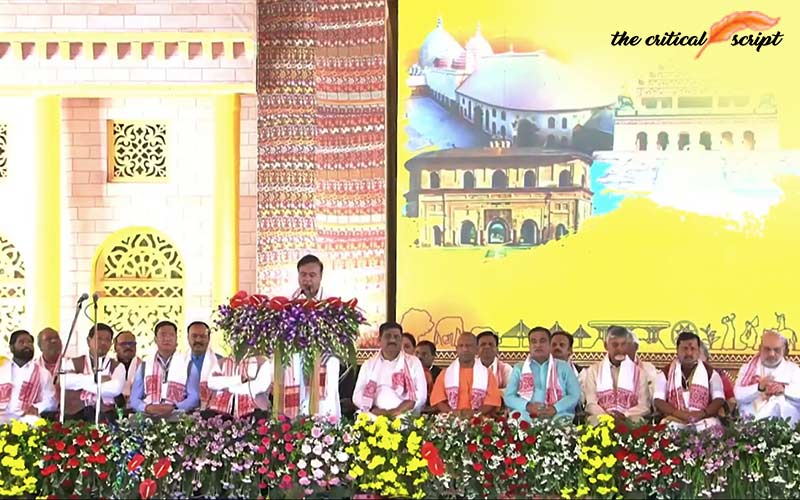
HimantaBiswaSarma’s Second Term: Power, Polarisation and the Burden of Expectations
With a renewed mandate and a stronger political grip over Assam, Himanta Biswa Sarma enters his second term as Chief Minister at a moment when the state stands deeply transformed - politically, socially and psychologically. What began as a carefully engineered political shift after his exit from the Congress has now evolved into one of the most dominant political eras Assam has witnessed in decades.
But second terms are often more difficult than first ones.
The first five years allowed Himanta Biswa Sarma to function as a political disruptor being aggressive, energetic and constantly on the offensive. The second term, however, will test whether he can evolve from a successful election-winning strategist into a long-term statesman capable of balancing development, identity and social stability in one of India’s most sensitive states.
The Politics of Control
Few regional leaders in India today exercise the level of political control that Himanta Biswa Sarma currently enjoys in Assam. He dominates not just the government, but also the political narrative, media discourse and electoral imagination of the state.
His leadership style is centralised, fast-moving and highly personalised. Unlike earlier Assam chief ministers who often relied heavily on party structures or bureaucratic consensus, Sarma has cultivated a direct and visible style of governance where the image of the government and the image of the leader increasingly merge into one.
This has brought political efficiency, but it has also concentrated enormous expectations on a single individual.
Today, every major question in Assam from floods to jobs, identity politics to investment ultimately circles back to Himanta himself.
That creates both strength and vulnerability.
Beyond Roads and Headlines
There is little doubt that Himanta Biswa Sarma’s first term succeeded politically because it projected momentum. Roads were built rapidly, welfare schemes expanded, infrastructure announcements multiplied and the administration appeared far more active than many previous governments.
Yet beneath the optics of growth, deeper structural anxieties remain unresolved.
Unemployment continues to haunt educated youth across Assam. Government jobs remain the primary aspiration for a large section of the population because private-sector opportunities remain limited. Industrialisation, despite repeated promises, has not transformed Assam’s economic reality in the way many had hoped.
Much of the visible development remains concentrated around infrastructure expansion and symbolic projects rather than broad-based economic transformation.
The challenge before Sarma’s second government is therefore not merely to continue construction, but to fundamentally reshape Assam’s economic future.
Without meaningful job creation, the political confidence of today can slowly turn into social frustration tomorrow.
Floods: Assam’s Eternal Political Failure
No issue exposes the limits of governance in Assam more brutally than floods and erosion.
Every year, the cycle repeats itself. Villages disappear, embankments collapse, families are displaced and vast areas remain submerged for weeks. Governments announce packages, conduct aerial surveys and promise long-term solutions, yet the Brahmaputra continues to overpower administrative claims year after year.
For all the political confidence surrounding the BJP government, Assam still lacks a comprehensive and permanent flood management vision.
This matters politically because floods are not merely environmental disasters in Assam. They shape migration, poverty, agriculture, public anger and electoral behaviour.
A second Himanta term will increasingly be judged not by speeches or campaigns, but by whether ordinary Assamese families feel more secure during the monsoon than they did five years ago.
The Rise of Identity Politics
If development formed one pillar of Himanta Biswa Sarma’s political success, identity politics formed the other.
Few leaders have understood the emotional undercurrents of Assamese anxieties as effectively as Sarma. Questions surrounding illegal immigration, demographic change, land encroachment and indigenous identity have been central to his political messaging.
He succeeded in transforming these concerns into a broad Hindu consolidation that cut across caste and regional divisions.
This has altered Assam’s political landscape dramatically.
For decades, Assam politics revolved around Assamese nationalism versus Delhi. Under Himanta, the framework increasingly shifted toward civilisational and demographic anxieties tied to religion and migration.
Supporters argue that he articulated fears many Assamese people already carried privately. They view him as a leader willing to confront issues earlier governments avoided.
Critics, however, argue that this politics has deepened social divisions and normalised suspicion between communities.
The concern is not simply electoral polarisation. It is the possibility of long-term psychological separation within Assamese society itself.
Minority Politics in the New Assam
Minority politics under Himanta Biswa Sarma has entered an entirely new phase.
Muslim voters in Assam today appear more politically consolidated than before, particularly after the decline of the AIUDF and the strengthening of Congress in several minority-dominated regions. At the same time, the BJP has consolidated Hindu votes at an unprecedented scale.
This has created a sharply polarised electoral structure where religion increasingly determines political alignment.
Sarma’s critics accuse him of using aggressive rhetoric and eviction drives to create political polarisation. Several Bengali-speaking Muslim communities feel targeted by repeated political narratives linking migration, land and demographic change.
Supporters counter that his government is addressing illegal infiltration and protecting indigenous land rights rather than targeting Indian Muslims.
But regardless of political interpretation, the social consequences of this polarisation are becoming increasingly visible.
Assam today appears politically more stable than it did a decade ago, yet socially more divided.
This contradiction may become one of the defining realities of Himanta’s second term.
The Burden of Dominance
Political dominance creates its own dangers.
When a leader becomes too electorally successful, institutions around him often weaken. Opposition spaces shrink, internal criticism reduces and political debate becomes increasingly personalised.
In Assam today, Himanta Biswa Sarma towers over both allies and opponents. But history shows that highly centralised political systems eventually become vulnerable to fatigue, overconfidence and public impatience.
Second terms are rarely won through energy alone. They require restraint, institution-building and legacy thinking.
The central question now is whether Himanta continues to function primarily as a campaigner constantly fighting political battles or whether he transitions into a leader focused on long-term social stability and economic transformation.
A Defining Political Moment
Himanta Biswa Sarma has already secured his place as one of the most consequential political figures in Assam’s modern history.
But the second term will determine how history ultimately remembers him.
As the leader who transformed Assam economically while balancing identity and development?
Or as the architect of a politically dominant but socially polarised era?
The answer will not emerge from election victories anymore. It will emerge from governance, social harmony, economic outcomes and the lived realities of ordinary Assamese people over the next five years.
Disclaimer: The opinions expressed in this article are those of the author's. They do not purport to reflect the opinions or views of The Critical Script or its editor.
Politics Related Posts








Newsletter!!!
Subscribe to our weekly Newsletter and stay tuned.
Related Comments