


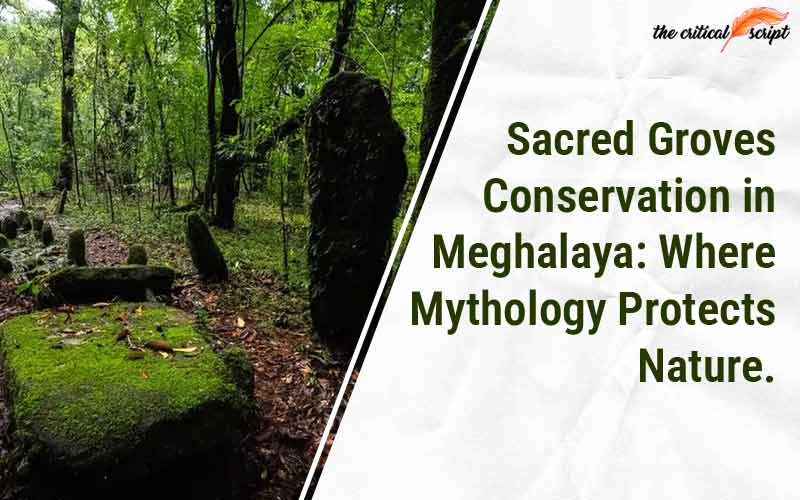
Sacred Groves Conservation in Meghalaya: Where Mythology Protects Nature
In the mist-covered hills
of Meghalaya lie one of the most remarkable examples of indigenous
conservation: the sacred groves. These sacred groves (called as ‘law Kyntang’,
‘Law Niam’ and ‘Law Lyngdoh’ in Khasi hills, ‘Khloo Blai’ in Jaintia hills, and
‘Asheng Khosi’ in Garo hills) are owned by individuals, clans or communities,
and are under direct control of the clan councils or local village
Dorbars/Syiemships/Dolloiships/ Nokmaships.
These forest patches have
been preserved for centuries not through formal laws, but through deeply rooted
spiritual beliefs, myths, and cultural practices. Long before modern
conservation frameworks emerged, local communities developed a system in which
nature was revered and protected, creating a sustainable model that endures.
What Are Sacred Groves?
Sacred groves are forest
areas protected by local communities because of their religious and cultural
significance. In Meghalaya, these groves often date back centuries and are
found across many Khasi villages, where they are regarded as living embodiments
of spiritual presence rather than mere ecological zones. Their preservation is
not enforced by external authorities but is maintained through customary practices
and community belief systems, making them unique examples of decentralized
conservation.
Mythology and Spiritual Beliefs
The protection of sacred
groves is deeply intertwined with mythology and spiritual belief. Among Khasi
communities, these forests are believed to be inhabited by deities and
ancestral spirits who act as guardians. It is widely held that any disturbance
within the grove, whether cutting trees or removing even the smallest natural
object, can invite misfortune or illness. These beliefs are passed down through
oral traditions, stories, and rituals, ensuring that respect for the grove
remains deeply embedded in community consciousness. This spiritual framework
effectively functions as a self-regulating system of conservation.
Cultural and Social Significance
Sacred groves play a central role in the cultural and social life of local communities. They serve as spaces for rituals, ceremonies, and offerings, where people connect with their ancestors and spiritual forces. The presence of a sacred grove is often tied to the identity and heritage of a Sacred groves play a central role in the cultural and social life of local communities. They serve as spaces for rituals, ceremonies, and offerings, where people connect with their ancestors and spiritual forces. The presence of a sacred grove is often tied to the identity and heritage of a village, symbolizing continuity and tradition. These forests are therefore not just ecological assets but also cultural institutions that reinforce social cohesion and collective values.
Ecological Importance
From an ecological perspective, sacred groves are invaluable reservoirs of biodiversity. Because they remain largely undisturbed, they support a wide range of plant and animal species, including rare and endemic varieties. They function as natural gene banks, preserving ancient ecosystems that have disappeared from surrounding areas. Additionally, these groves contribute to environmental stability by maintaining water sources, supporting soil conservation, and regulating local climate conditions. Their ecological richness often surpasses that of nearby managed forests, highlighting the effectiveness of traditional conservation practices.
Case Study: Mawphlang Sacred Grove

A well-known example is the
sacred grove of Mawphlang, which is believed to be over 800 years old. This
grove is rich in biodiversity, containing numerous species of plants, including
those with medicinal value. It is protected entirely through customary laws and
spiritual beliefs, and visitors often describe the experience as entering a
natural sanctuary imbued with a sense of reverence and silence. The grove
stands as a powerful illustration of how tradition and ecology can coexist
harmoniously.
Some other Groves of
Meghalaya
Law Lyngdoh (Mawsmai Sacred Grove)

Situated near Cherrapunji (Sohra), this grove is protected by the Lyngdoh clan. It is associated with strong spiritual beliefs and plays an important role in preserving local biodiversity.

Located in Nartiang in the Jaintia Hills, this grove is linked with traditional rituals and the nearby monolith heritage site. It reflects the spiritual practices of the Jaintia community.
Raliang Sacred Grove
Found in Raliang, this grove is another important conservation site where traditional beliefs strictly regulate human activity, helping preserve rare plant species.
Law shnong (Village Sacred Groves)

Across Meghalaya, many villages maintain smaller sacred groves known as Law shnong. Though less famous, they are equally important in sustaining local ecology and cultural traditions.These groves collectively form a network of community-protected forests, preserving biodiversity, sustaining water systems, and safeguarding indigenous belief systems.
Indigenous Conservation Model
Sacred groves demonstrate that conservation can be most effective when it is rooted in culture and belief. The system is characterized by community ownership, spiritual enforcement, and the transmission of knowledge across generations. Unlike modern conservation approaches that rely heavily on legal frameworks and enforcement mechanisms, this model depends on shared values and collective responsibility, making it both resilient and sustainable.
Emerging Challenges
Despite their strength,
sacred groves face increasing challenges in the modern era. Urbanisation,
changing land-use patterns, and a gradual decline in traditional belief systems
among younger generations pose significant threats. Additionally, unregulated
tourism and environmental changes linked to climate shifts are beginning to
impact these fragile ecosystems. As cultural connections weaken, the
effectiveness of traditional protection mechanisms may also diminish.
The Way Forward
Ensuring the survival of
sacred groves requires a balanced approach that integrates traditional
knowledge with modern conservation strategies. Strengthening community
involvement, promoting responsible eco-tourism, and documenting oral traditions
can help preserve both the cultural and ecological value of these forests.
Recognizing sacred groves as heritage sites can also contribute to their
long-term protection.
Sacred groves in Meghalaya
represent a rare and powerful convergence of mythology, culture, and
environmental stewardship. They demonstrate that conservation is not solely a
scientific or administrative endeavor but also a deeply cultural and spiritual
practice. In an era of ecological uncertainty, these forests offer an enduring
lesson that when nature is respected and revered, it can be protected for
generations to come.
Disclaimer: The opinions expressed in this article are those of the author's. They do not purport to reflect the opinions or views of The Critical Script or its editor.
Earth Science Related Posts












Newsletter!!!
Subscribe to our weekly Newsletter and stay tuned.
Related Comments