


 INDIA ASIAN GAMES MEDAL MONITOR
·
India: 🥇 0
| 🥈 0
| 🥉 0
| Total: 0
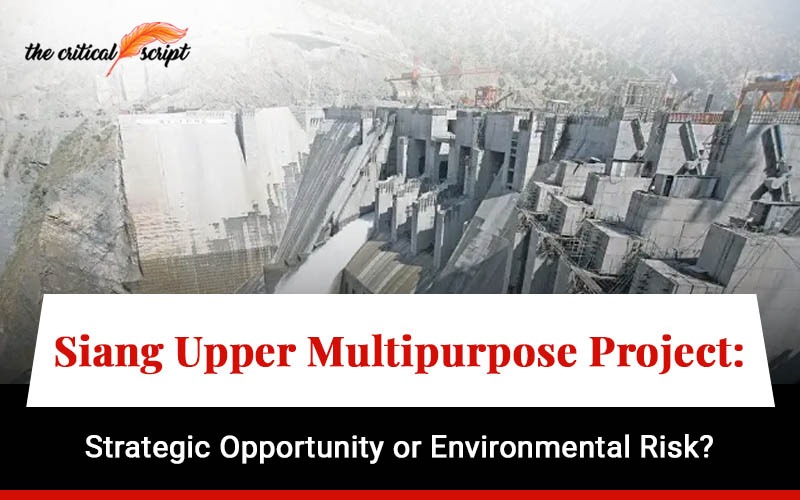
Siang Upper Multipurpose Project: Strategic Opportunity or Environmental Risk?
The proposed 11,200 MW project could strengthen India's water and energy security, but concerns over seismic safety, ecological damage and indigenous rights raise important questions about its long-term viability.
The proposed Siang Upper Multipurpose Project (SUMP) in Arunachal Pradesh has emerged as one of the most consequential infrastructure debates in Northeast India. Envisioned with an installed capacity of approximately 11,200 MW and around 9.2 billion cubic metres of live storage, the project aims to combine hydropower generation with large-scale water storage and river-flow regulation. Yet, while the government highlights its strategic and economic potential, sections of the indigenous population have raised concerns about displacement, environmental damage and the future of their ancestral lands.
The debate is therefore not simply about whether India needs more electricity or whether large dams are beneficial. It is about whether the potential advantages of SUMP can justify its environmental, social, and financial costs.
Why the Project Matters
Water Security and Strategic Considerations
The Siang enters India from Tibet, where it is known as the Yarlung Tsangpo, before becoming part of the Brahmaputra River system. China's plans for major hydropower development upstream have raised questions in India about the potential implications for downstream water flows.
The proposed SUMP could provide India with substantial storage capacity to manage water within its own territory. Depending on the final design and operating arrangements, this could support seasonal flow regulation and potentially moderate certain high-flow events.
However, the extent of these benefits remains to be established through hydrological studies. A reservoir cannot guarantee protection against every flood, nor does its existence automatically neutralise risks associated with upstream infrastructure.
Clean Energy and Electricity Supply
With an envisaged capacity of 11,200 MW, SUMP could make a substantial contribution to India's electricity system if it proves technically and economically viable.
Hydropower can complement solar and wind generation by providing electricity when their output fluctuates, subject to water availability and reservoir operating constraints. It also generates power without directly burning fossil fuels during operation.
For a country with rising electricity demand, this potential is significant. However, the project's actual contribution would depend on construction costs, geological conditions, generation estimates, and its environmental footprint.
Employment and Regional Development
A project of this scale could generate employment during construction and create demand for transportation, construction materials, technical services and other local businesses.
Associated infrastructure could also improve connectivity and support economic activity in the Siang region. With appropriate planning, local residents could benefit from skill development, employment and business opportunities.
The challenge is ensuring that these benefits reach affected communities and are sustained beyond the construction phase. Economic projections must also account for rehabilitation costs, environmental mitigation, and the loss of existing livelihoods.
The Concerns That Cannot Be Ignored
Seismic Safety and Geological Uncertainty
The eastern Himalayas are seismically active, and the proposed project would require extensive geological and seismic investigation.
A large dam must be designed to withstand the relevant earthquake hazards, while reservoir operations must account for changing geological and hydrological conditions. Potential risks associated with landslides, extreme rainfall, glacial lake outburst floods and heavy sediment loads also require careful assessment.
These factors do not, by themselves, prove that the project is unsafe. Equally, its proposed benefits do not establish that it can be built safely. Independent technical scrutiny must determine whether an acceptable level of safety is achievable.
Environmental Impact
The Siang valley contains forests, river ecosystems and habitats that could be affected by reservoir formation and associated construction.
Large infrastructure projects can alter natural river flows, obstruct fish movement, change sediment transport and affect biodiversity. Forest clearance and the creation of a reservoir could also have consequences extending beyond the immediate project site.
A comprehensive environmental assessment must examine these impacts alongside the cumulative effects of other development in the river basin. It should also compare alternative designs and options for achieving some of the same energy and water-management objectives with a smaller environmental footprint.
Indigenous Rights and Displacement
For sections of the Adi community and other residents of the Siang region, the debate concerns more than land acquisition. Ancestral territories, agricultural land, traditional livelihoods and culturally significant places are closely connected to community identity.
Local organisations have opposed the project and its ongoing pre-feasibility activities, raising concerns about the consultation process and the deployment of security personnel during survey-related tensions.
These concerns require substantive engagement rather than dismissal. Any decision to proceed must address the rights of affected people, transparent rehabilitation arrangements and the long-term viability of replacement livelihoods.
Consultation should be meaningful from the earliest stages of assessment. Communities need clear information about possible impacts and a genuine opportunity to raise questions before irreversible decisions are taken.
Financial Costs and Long-Term Viability
Mega-dams require substantial investment, long construction periods and extensive supporting infrastructure. Geological difficulties, delays, rehabilitation requirements and environmental mitigation can significantly affect project costs.
The economic case for SUMP must therefore be based on realistic estimates of construction expenditure, electricity generation, financing costs and long-term maintenance. It must also account for environmental and social costs that may not be fully reflected in conventional financial calculations.
A project of national importance still needs to demonstrate that its expected benefits justify the resources and risks involved.
What Would a Responsible Way Forward Look Like?
The immediate priority is to establish the project's feasibility rather than assume its construction is inevitable.
The Preliminary Feasibility Report is intended to assess whether, where and how the project could potentially be developed. If it is found viable, further environmental and social assessments, a Detailed Project Report, statutory clearances and consultations would be required before a construction decision could be considered. The state government has reiterated that the feasibility process should inform the decision rather than predetermine it.
A credible process should include:
● Independent seismic, geological, and dam-safety assessments.
● Transparent disclosure of hydrological, environmental and economic findings.
● Assessment of cumulative impacts across the Siang-Brahmaputra basin.
● Meaningful engagement with affected communities and respect for applicable legal rights.
● Fair rehabilitation and livelihood plans if displacement proves unavoidable.
● A comparison with alternative project designs and other energy and water-management options.
The findings should be allowed to influence the final decision, including the possibility of modifying the proposal or not proceeding if the risks prove unacceptable.
Potential Benefits, Real Risks
The Siang Upper Multipurpose Project presents a genuine policy dilemma. Its proposed storage and generation capacity could support India's water and energy security, while investment may create opportunities for regional development. At the same time, seismic uncertainty, ecological sensitivity, financial exposure, and the rights of indigenous communities raise serious questions that cannot be answered by strategic arguments alone.
The appropriate approach is neither to assume that the project must be built nor to dismiss its potential without examining the evidence.
SUMP should be judged on whether its benefits can be demonstrated, its risks adequately managed, and its development process made transparent and inclusive. The outcome of the feasibility studies and the quality of engagement with affected communities will be central to determining whether the project represents a viable development opportunity or carries costs that outweigh its potential gains.
Disclaimer: The opinions expressed in this article are those of the author's. They do not purport to reflect the opinions or views of The Critical Script or its editor.
Social Related Posts











Newsletter!!!
Subscribe to our weekly Newsletter and stay tuned.
Related Comments